Showing posts with label monster. Show all posts

Bird Box (2018)


For reasons I'm sure you can guess, I've been feeling more inclined to watch vaguely (and explicitly) apocalyptic films, lately. I don't want disease, because... too soon... but zombies and other stuff is fair game. With this in mind, it seemed like a good time to give Bird Box a try, as the initial "meh!" reviews put me off when it first dropped on Netflix. How bad could it be, though? I was still interested enough to chance it.

The first time I heard about this I thought (cw: Harry Potter) "HORROR BOGGART!" and it still stands, to be honest. Directed by Susanne Bier, based on a story by American novelist Josh Malerman (the screenplay by Eric Heisserer) we join the story switching between current day and flashback, meeting Malorie (Sandra Bullock), her sister (criminally under-used Sarah Paulson!) and gradually some other characters in a Dawn of the Dead (2004) type ensemble cast of people stuck together in one location. 

Trope roll call!
  • Sexy, tough female
  • Tattooed, creepy skinny guy who wants to fuck (it's Machine Gun Kelly but I'm old and don't know who that is *shrug*)
  • Grumpy widow (hi, John Malkovich)
  • Funny black dude
  • Soft-hearted lady who makes dubious decisions
  • Competent/kind/hot war veteran

Malorie stands out at the obvious lead here. She's tough, smart, empathetic - and heavily pregnant. She doesn't take shit and doesn't suffer the selfish whims of others gladly. Throughout this flashback we see the incredibly rapid end of the world (as they know it) from weird news stories ("don't worry, it's happening in another country, not here" - gulp!) to people behaving oddly, to full on societal crumble in a matter of minutes.


I am a stone cold sucker for tipping point apocalypse stuff, so this may have been my favourite aspect of Bird Box. The subtlety of the initial weirdness, paving way for the eventual riot and complete destruction of humanity. I dig it, although this stretch of the movie is pretty predictable for anyone remotely aware of the narrative beats of this genre. 

End-of-world ensemble emotions roll call!
  • Suspicion
  • In-fighting
  • Bonding
  • Double-crossing
  • Loss
  • Deception

You know what I'm talking about.

The threat to these characters works well enough; you either lose your mind and commit suicide upon seeing the monsters, or you lose your mind and try to convert others to look at them. There's some not-very-gross-but-still-cool eye effects work, too.


What didn't catch for me were the gigantic leaps in logic and suspension of disbelief required for this story. I've said many times before that when I, Jo, say this, it's a big red flag. I don't usually get this shit stuck in my throat with movies; I'll pick up just about anything you are putting down. However, Bird Box puts down a little too much. Between driving blind from a suburban neighbourhood to a supermarket literally only using the GPS (and said device not functioning the way normal ones do) to lapses in logic when it comes to personal safety when looting... this was a lot for me swallow from a film that was just okay.


It also confirmed something I already knew: I am a horrible person. I turned to my partner and said "I hope one of the kids dies in this". Oops? But I did! I needed something to sink my teeth into! They didn't have the courage to do anything other than mild peril, though.

Speaking of, interestingly (but not surprisingly) the book this was based on had a much more downbeat ending. Malorie reaches her destination, but rather than a paradise of smiling people and a former school for the blind, the book describes a place where the inhabitants have willingly blinded themselves so as not to fall prey to the monsters, and the "sanctuary" offers little more than what the family had already. Points deducted for shaving the sharp edges off of that, Bird Box producers! 

Apocalypse-lite. Streaming on Netflix now.

The Ritual (2017)


I fancied watching this again recently, and I'm really glad I did. Spoilers incoming!

Based on a novel by Adam Nevill, directed by David Bruckner (who co-wrote and directed Amateur Night in V/H/S and The Accident in Southbound) this Netflix movie takes us deep into dark Swedish forests with a group of friends.

Dom, Luke, Phil and Hutch.

Tension exists between these men, as we find out that Luke (Rafe Spall) carries a heavy burden of guilt for not stepping in during a violent attack which opens the film. The knowledge they all have of Luke essentially standing by as their friend Robert (Paul Reid) was killed hangs heavily over the beginning of their trip. We see Luke wake from a nightmare about the murder, and throughout our time with him images ripple through his reality of the trauma from that night.

These scenes are some of my favourites, as imagination and reality/fabricated building interior and forest mesh so effortlessly and organically together. It's incredibly impressive and extremely disconcerting. It reads very much like something out of a dream, where details and settings bleed together in a singular landscape.


On the night Rob died the lads were trying to decide where to go on holiday together, and now, six months later they find themselves hiking as a tribute to him (as he'd originally suggested it). Hutch (Robert James-Collier) is clearly the most comfortable in the outdoors, with the others joining through a sense of sad duty. These are middle-class affluent types, paying £200 for their hiking boots but neglecting to break them in before the trip. They are kind of out of their depth before they even set foot in the forest.


The turning point of events comes after Dom (Sam Troughton) gets hurt, and they make the decision to take a short-cut back to their lodge. Rather than staying out in the open, they realise with reluctance that entering the dense forest is the quickest way back.


❝What's up? Are you scared of the woods?❞


It's dark, damp, and visibility is low through the arrow-straight trees. Luke repeatedly thinks he sees a glimpse of something moving in the distance and tensions increase as pain and exhaustion take hold. Everything changes after their first night in the forest. Breaking into an abandoned cabin during a storm, they wake the following morning, nerves shredded from terrifying nightmares and sleepwalking. 

There is a palpable feeling of a dark presence infiltrating their minds as they slept, pushing its way into their deepest fears. The most alarming awakening is from Phil (Arsher Ali) who is found naked in a "praying" position in front of a terrifying headless totem.


No one, especially Phil, is ever the same after that night. Arsher Ali doesn't have an awful lot to do aside from this, unfortunately, but he gives a haunting performance as someone who can't process or escape the fear of his ordeal. Phil is shell-shocked and violated.


Similar to the "lost in the woods" idea, the stripping back of anything our characters have -  in this case: possessions, unity, sanity - is not a unique narrative approach, but in capable hands, it's so effective. The lads start with the latest gear, and end with nothing, having lost tents, party members, and a full grip on what the fuck is even going on. With a steady hand, The Ritual peels back to the terrified primal core of these characters.


The creature reveal is what solidifies the success of this movie for me. This beast is a "Jötunn", an ancient god worshiped by villagers and offered sacrifices of unsuspecting visitors to the area (their possessions dot the landscape, nature claiming them in varying degrees). In turn, the locals are granted unnaturally long lives. The things we do for eternity, eh? I did find it interesting that none of the villagers seem particularly happy, however. Their lot appears more duty and fear-fueled than actively wanting to be eternally stuck in this existence.

The design of the Jötunn is stunning, even in full view it's difficult to comprehend as it seems compromised of human and beast body parts, as well as having aspects of the forest, too. It feels profane in a way that both captivates and repels.

As Luke attempts to escape his fate of being trapped forever, this showstopping moment is captured:


If he had lost his mind then and there, who could have blamed him?

As the third act draws to a close, the warm tones of a burning village give way to a landscape bathed in dawn light. In the far distance we see a car on a road. Luke is returning to civilisation and leaving old gods behind. At least physically. He was chosen because his "pain was great" - is his pain gone, by the end? I doubt it. If anything it's deeper, along with his guilt. His primal scream at the creature stuck at its forest's edge certainly hints at a lifetime of nightmares to come. 

This movie would pair well with Blair Witch for a night's viewing, as I think they'd complement one another for a "we're lost in the woods and we're f*cked!" double bill. Tents and trees by torchlight; distant, gigantic sounds you can't identify... That kind of fear pre-dates almost everything, it's woven into our lizard brains.


The Ritual is streaming on Netflix now. I appreciated the abrupt, not-necessarily-sad but definitely not happy ending (see also: Calibre). Beautiful landscapes, old gods and flawed humans - what's not to love? Very tempted to pick up the book and see how the two compare.

Digging Up the Marrow (2014)


If you say "lower-budget passion project about monsters", I'm usually going to reply with "yes please". However, with Digging Up the Marrow, I'm having some slight viewer's remorse.


This "found footage" mockumentary is a strange mix of smug self-congratulation and geeky love letter from writer/director Adam Green. The creatures are drawn and designed by Alex Pardee and sculpted by Greg Aronowitz and they, along with the excellent Ray Wise, are the best thing about it.


We follow Green as he abandons writing duties for his then-popular (and real) TV show Holliston to go monster hunting with a man called William Dekker (Wise). Accompanying them is Green's real-life cinematographer and collaborator Will Barratt, who acts as camera man.

Wise was cast as an audience "signpost" of sorts so that they didn't get too convinced that this might be real and feel cheated at the first big reveal. While I get the logic of this, Wise's amazing, intense, wild-eyed self sits awkwardly next to literally everyone else onscreen. From Green's staff to cameos from other genre names, the acting in this is worse than daytime soaps. The dialogue, apparently scripted, does nothing to help matters as it's so uninteresting and long-winded that it comes across as bad improvisation.


This kind of criticism - and sadly, it's one I have with some regularity in this sub-section of horror - always makes me ponder the nature of "reality" a bit. Yes, the point of this is that it's meant to be amateur and real, so what's the problem? The problem is that to be enthralling and tense, this shit still needs a framework of considered, careful choices on which to drape its reality. As a filmmaker and horror obsessive himself, I would have assumed Green had better judgement than what is shown here.

And to get petty for a second, Green and his staff are almost exclusively shown wearing T-shirts advertising his own work... It's just a bit much? 

Is this a meta wink? Or does Digging Up the Marrow just have something in its eye?

And they all look brand new. I don't know why this irritated me so much.


This took five years to make, and I have to be brutal and ask, was it actually worth it? I see what he was trying to accomplish, but he just didn't get there soon enough or enough, enough, for my liking.


"Dig it up" on Shudder now. (...sorry).

Little Deaths (2011)


I've been rolling the British-made Little Deaths around in my head since I watched it a few days ago, wondering what exactly to say about it. If you can't stop thinking about a horror movie - does that make it good? This is an odd one.

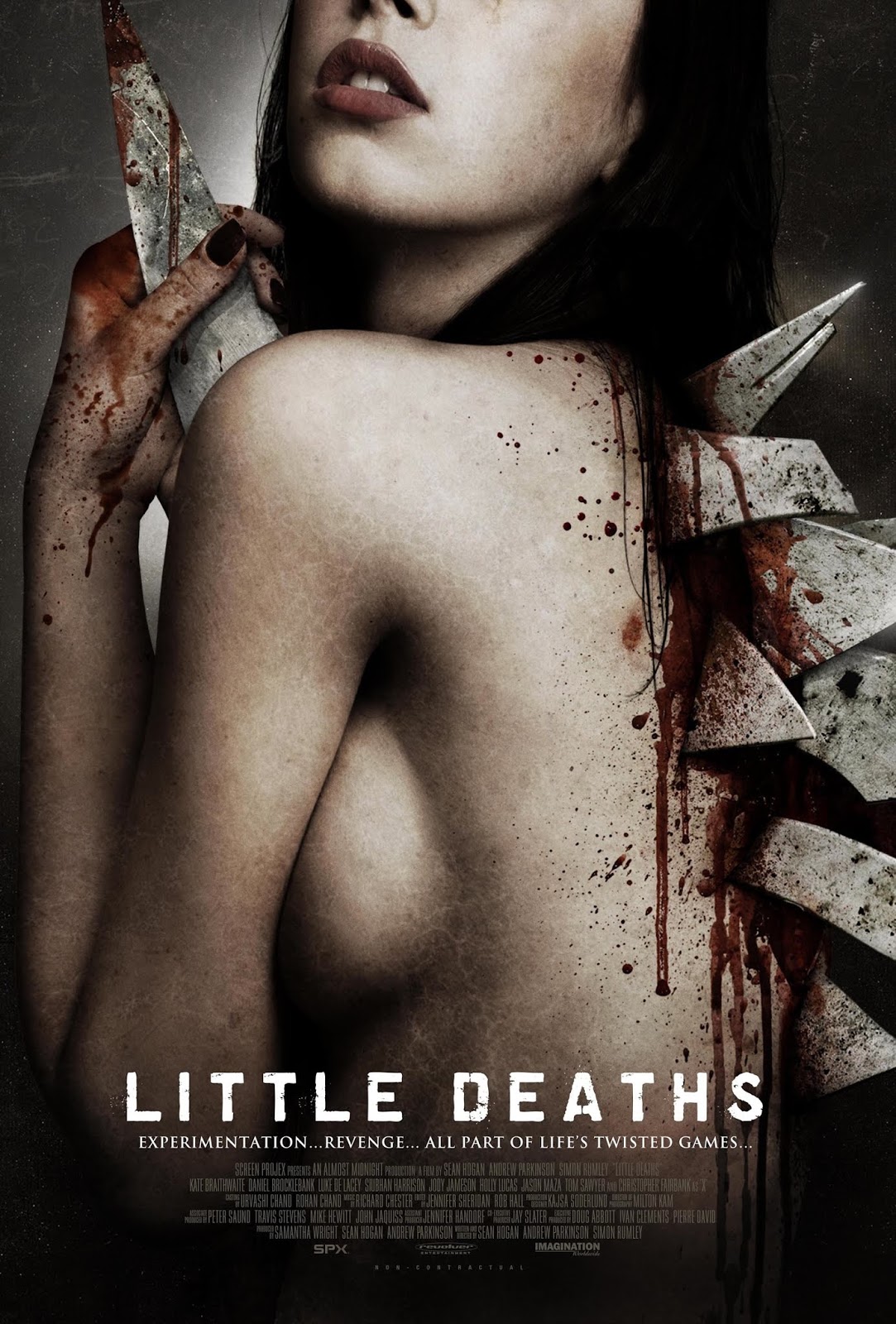
Little Deaths, as the name and the artwork suggests, is about sex and death. Two staples in our genre. Here we have three shorts collected together but without any wraparound or connecting threads. I suppose it's a bit like The ABC's of Death, with nothing but a common theme to unite the work.


This isn't necessarily a bad thing, but I feel it works better with larger projects (like the alphabet). For this, when the credits rolled after the third story, it felt undercooked, somehow? I hadn't been keeping track of the time but I had assumed there'd be more than three segments in this anthology.

Anyhow, this trio of tales has elements of sex, death, and also revenge. House & Home (written/directed by Sean Hogan) seems to generally be considered the best of the three - at least judging by the Letterboxd reviews. It concerns an affluent couple whose hobbies include kidnapping and abusing young homeless women. This is a pretty typical "they picked on the wrong girl this time!" story, though the reveal wasn't quite what I was expecting. It's fine enough, but the degradation that comes before the payoff made me feel uneasy and kind of exhausted. 


Mutant Tool (written/directed by Andrew Parkinson) is bonkers but loses a lot of its impact due to its plodding plot. I am a fan of stories about imprisoned and exploited entities, so long as they escape and the captors get their comeuppance. This doesn't exactly happen here, but the ending is satisfactorily dark.

The third and final tale is Bitch (written/directed by Simon Rumley), and it's the one I've thought the most about post-viewing, but I honestly can't decide if I like it or not. 

Here, we witness the day-to-day goings on in an abusive relationship between Claire (Kate Braithwaite) and Pete (Tom Sawyer). Claire is mean and manipulative; she does what she wants and makes Pete feel bad until he goes along with it, treating him like shit in front of his friends as well as in private. They have a kinky "puppy play" situation where Pete wears a mask and leash, crawls around on all fours, and gets pegged by Claire (and sleeps in a kennel in the spare room) but we get the distinct impression that this is more for her enjoyment than his. Ultimately, after she literally fucks one of his friends right in front of him, Pete breaks. He begins to set up a revenge plot that preys upon her deepest fears.


This story is tough to watch, it goes without saying, as abuse is never a fun thing to witness. Sawyer does well in portraying Pete as a sweet bloke trapped in his relationship. He seems constantly agonised and yet the crumbs of affection or interest Claire throws him, plus the hope that things will improve are enough to keep him from leaving. 

Claire is - aptly, given the title - shown almost entirely as a bitch. A horrible, selfish, abusive woman. Her moments of phobia are the only glimpse we get into something deeper or less repulsive about this character. As the villain, I guess this makes sense, but it's a shame to see such broad strokes used. Tackling an abusive relationship from the lesser-represented side of a male survivor is refreshing, but painting Claire so one-dimensional makes it come across more like Rumley just fucking hates women. Her unpleasant fate is not entirely clear, and I hope this was the creator's intent and not an oversight. I won't spoil it, but I have my reasons for disagreeing with a few reads I've seen of what becomes of her.

(aside: well... yikes. I just found out that Rumley also directed the most upsetting segment of the aforementioned The ABC's of Death: P is for Pressure. So honestly, I'm not going to waste too much time wondering what his motivation was here).

I think what got to me most about Bitch was its use of music as it's made clear what Pete is doing. An emotive, uplifting instrumental plays over this montage, stopping with jarring immediacy on a shot of him weeping at what he's done. It's my favourite part of the entirety of Little Deaths, though I'm not sure it's enough to redeem the whole thing...

This is streaming on Shudder at time of writing. It's barely over 1hr30 so if you feel like gulping down three odd little stories, you could do a lot worse??

The House of the Devil (2009)


If you've heard one thing about Ti West's The House of the Devil, it's more than likely how successfully it mimics the slasher films of the 70s/80s, despite being from the early 2000's. The level of detail and care is indeed astounding, with really only some familiar genre actors giving the game away.

There are clear acts in this movie; the first introducing us to Samantha (Jocelin Donahue), a sophomore at university who's looking to move out of her shared dorm into a cool new apartment. Donahue plays Sam perfectly and charmingly unremarkable - an opening scene shows she's "landlady approved": testament to how vanilla she is - and both her sexually active, punk roommate and street-wise best friend Megan (Greta Gerwig) appear to be more interesting characters. Sam has uncomplicated wants at this point in her life: she just needs enough money to write the aforementioned new landlady (Dee Wallace!) a cheque.


❝It could be awful. It could be from hell.❞
− Megan.

The second act establishes that Sam is so desperate for money that she's willing to make some questionable decisions when it comes to a babysitting gig she answered an ad about. She accepts the job for that night - a night of a lunar eclipse, no less - with little-to-no information, and when she meets the family, she ignores her instincts (and those of Megan) about how increasingly odd this all is. We watch her make herself at home in what is a quintessential house for this type of movie (think the sorority house in Black Christmas but scaled down a bit; lots of stairs and passageways). She orders pizza, dances around to her Walkman, and does a little light snooping. Normal babysitter stuff.


Come the third act, Sam has shed the shackles of her earlier worry, and descended through woozy fear into full blown survivalist hysteria. Behind the doors she neglected to open during her nosing, this house holds its darkest secrets, and once she wakes up to them it's the beginning of the end.


Shot on 16mm film and using the same techniques from that time too, this is both a loving tribute and an enjoyable movie in its own right. Claiming to be based on true events from the "Satanic Panic" era in the US, its 95min runtime makes use of every second to establish Sam's plain existence and then tear it apart.

This awareness of itself in the best possible way, along with a gently creepy turn from Tom Noonan, and beautifully sewn seeds of dread as the film progresses, plus some wonderful, Exorcist-like subliminal work in the final act, make The House of the Devil an absolute treat.


It's streaming on Shudder at time of writing. 

Once you've seen it, check out some of the alternative/fan-made poster art that can be found online. There are some truly gorgeous ones out there and people really had fun with the retro vibe.

Spring (2014)


Relevant to this time of year, Spring is a beautiful film about love ❤

This one was recommended to me ages ago, but I've a habit of deliberately putting off films I'm certain I'm going to really like. Does anyone else do this? The timing has to be right, my mood has to be just so... I want to honour the film properly. So on the eve of Valentine's Day, I was ready. I dove in.


Spring benefits from you knowing as little as possible going in, so we're going to circle around the real meat of the plot here. We're introduced to Evan (Lou Taylor Pucci), a Californian with nothing much left to keep him there: he's lost both parents in quick succession, his best friend is wasted all the time, he has no job prospects and he's in trouble with the cops. Life is shit and he's miserable. To escape it all, he books a random ticket to Italy.

Once there, he meets a couple of rowdy Englishmen who show him the sights, and when they peace out and head to Amsterdam, Evan decides to stay and find work. He gets a job and lodging on a local farm and then attempts to get to know a gorgeous woman he keeps seeing around town.


Louise (Nadia Hilker) is at once mysterious, haughty, and captivating. The first time they talk she makes it clear she literally just wants to have sex with him. Finding this a little full-on, Evan suggests getting a drink together first: "I gotta make sure that you're the kind of crazy I can deal with."

They spend time together, and they eat, they drink, they talk and fuck. In the span of less than a week, they grow close. Louise is affectionate but evasive, sometimes unexpectedly running off or ducking out of dates early. Evan just accepts her as a tempestuous Italian woman, but we're shown tantalising peeks into her world, showing it's way weirder than that.


The layers are expertly peeled back, with the audience faintly aware of Louise's "issues", but not understanding the hows and whys. When Evan arrives at her apartment for the the most jaw-dropping scene of the movie, it starts a series of scenes of natural exposition, unfolding Louise's tale in all of its astonishing glory, and following Evan as he processes it.


I have to give special mention to the character of Evan, who is a genuinely good bloke. He wears his heart on his sleeve and he's just trying to get over some awful personal shit from back home. In his new situation we witness him work hard, have a cool relationship with his boss (an old olive farmer) and fall hard for Louise. You absolutely believe him when he expresses his feelings for her. The softness in his character is portrayed so well by Lou Taylor Pucci; he's vulnerable, but not mawkish; sensible (not just bedding Louise the minute he meets her, like she suggests) and self-deprecating. This is a male lead written in a way a lot of others could learn from!


With a story told so well, and mostly using natural locations (rather than dressed sets), this reminded me a lot of Monsters. It's a film whose location is a strong part of the story, acting almost as an additional character, and despite Spring's settings often being immense - wave-battered coastlines, churches, tombs, ruins - it all still feels so intimate. 

That feeling of falling in love, when you feel like the only two people in the world... Spring captures that.


My congratulations to directors Justin Benson (who also wrote the story) and Aaron Moorhead, and actors Nadia Hilker (who is also fantastic, please don't think otherwise) and Lou Taylor Pucci. This is a beautiful little monster and I'm already looking forward to watching it again.

Available to stream on Shudder right now ❤

Trollhunter (2010)


New favourite alert!

I started watching this Norwegian found footage tale more out of duty to my list, than actually being excited to see it. I am an idiot.

Taking the form of a documentary made by a few college kids about Hans, a mysterious hunter, this film handles its rather outlandish subject matter with confidence and humour.


Initially thought to be a bear poacher, it transpires Hans is the trollhunter of the title. He lives a lonely nocturnal life working for the TSS (Troll Security Service) smothering himself in stink and tracking and killing wayward trolls, thus keeping livestock and (unaware) human populations protected. 

Hans has seen some bad shit, and he's done worse. He's tired and sick of the bureaucracy of his job, so he lets the kids tag along for the ride, hoping to spread the word of this unknown threat and maybe have someone else take over the task of hunting.

That all sounds crazy, right? Well it's crazy how good this film is... especially considering that it makes some decisions I ordinarily think are bad ones in horror.

It shows the "monster" early, completely and throughout, for example. But this only serves to put us right there with the crew, jaws dropping and hearts pounding (and mine literally was) with every inconceivable encounter.


And it uses CGI, which shouldn't come as a surprise of course, but the way it's used sits so comfortably next to everything else that you just buy into it. I felt like a fool not being able to watch a CGI troll kill a CGI sheep onscreen... but it's just so bloody believable.

The acting is so natural, full of little moments that read as simple and real, so whether they were written that way or were an actor's choice, it doesn't really matter, both deserve credit.

Another clever touch is the inclusion of aspects already part of the stunning Norwegian landscape, such as electricity pylons; weaved into the narrative as if put there on purpose (as electric fences to deter trolls, obviously).


The use of the "already-existing" applies elsewhere, too.

Trolls have been present in Norse mythology and Scandinavian folklore dating back to 1276(!). In Trollhunter we have the beautiful juxtaposition of the amused disbelief of people who grew up reading fairy stories about these beings, next to Hans and others delivering cold hard facts about them. We learn gestation periods, life spans, why/how UV light harms them and whether the Tusseladd breed of troll is born with three heads or not (they aren't, and technically they aren't heads...). 

It's just a perfect narrative device, bringing these beings to life and making them legitimately scary in a more intellectual way than rewriting the mythology and doing something basic like attempting to give them a scary appearance.

Despite its fantastical subject matter, Trollhunter brings and successfully maintains an escalating sense of things getting worse. It opens with text explaining that this is literally a "found footage" film, so we know ultimately the kids at least go missing, if not worse. With this as a starting point it's just a matter of sitting and watching, wondering exactly how.


The tension is where this film gets you. As the pace gains momentum in perfectly timed increments, the trolls get bigger, the destruction increases and the hunter commenting on something being a "bad sign" gets more frequent.

The last big sequence actually made me flinch and exclaim out loud more than once. I cannot remember the last time a horror film did that! There's also a shot towards the very end that I found breathtaking.

For anyone put off by subtitles: don't be. I'm embarrassed to admit, sometimes I tell myself I'm just not in the mood... but bear in mind that because your focus has to be unrelenting on a film where you must read the dialogue, it really pays off. No glancing at social media, no multi-tasking; you have to pay attention! I had forgotten how much it actually adds to the overall enjoyment and vested interest in the movie.

There's thought and care with this film, right down to the very last word and the final song over the end credits. You should definitely check it out, if you haven't already done so!

Feast (2005).


Feast saved me from my periodic genre-grump by being a perfect balance of guts and guffaws.

It's 83mins of fine horror comedy, involving but not limited to: nasty monsters, limb dismemberment, geysers of blood.

And slime.

Oh, and Henry Rollins.

Occasionally wearing pink sweat pants.

This is another to add to the number of films I've been watching lately which are set in one location. Or, "submarine films" as director John Gulager describes them. It's a favourite tactic for film makers with a smaller budget as it keeps costs down, and I'm something of a fan of such flicks, I'm starting to realise.

A one-location deal tends to intensify. Without the bells and whistles distraction of a regular change of locale, more attention has to be paid to everything else. As ridiculous as it may sound, it takes the film one step closer to theatre.

Let's not get too serious, though. We are still talking about a film whose sequels are called Sloppy Seconds and The Happy Finish.

So the set-up here, as I'm sure you can guess: a motley group of employees and customers are trapped in a bar in the middle of nowhere - which just so happens to be under a nighttime assault from freakish monsters.


Feast decides to opt out of giving us any explanation for what these things are, or how they came to be there. With a film like this, this is more often than not the way to go. Back story, what's that? Let's just chop some heads off and throw blood in a girl's face.


The characters are introduced in the opening sequence by way of freeze frame sepia-tinted profiles. A bit like top trumps. This sounds overdone and a little groan-inducing, but it works in prompting the first of many laughs and instantly cluing the audience into who's who...


Trivia: this is the director's father.


Quite some time is spent establishing these character profiles... before roughly half of the cast get immediately wiped out in the initial monster attack. "Did that just happen?!" moments are one of my favourite things about the horror genre, and Feast hands them out unabashedly. It's nice and disconcerting not to be able to instantly guess who'll be dragging themselves over the ridiculously gore soaked finish line.

This is a film of simple pleasures of the Evil Dead variety. Practical effects and gross comedy are both out in force, often at the same time. Behold: a character peeks out of the shutters into the night, declaring: "I can't see a thing..." and then proceeds to get his eyeball torn out. While the optical nerve is being ripped from his head, he screams "Gimme my eye back!". This small scene encapsulates the spirit of the film. You as the viewer wince, laugh, feel a little nauseous. Perfecto.

"We build a doll and throw it through a window!"
Just about everyone involved in Feast was obsessed with gettin' as messy as possible and they say as much in the making-of documentary. The 'creature and makeup effects designer' Gary J. Tunnicliffe brought the gore using what one of the actors calls "80s retro" methods; delightful practical stuff which sees blood, latex, bone and hair being tossed around from the get-go. It takes some vision, apparently, to act with what looks like a stuffed animal as your co-star - but the results are so glorious!


The featurette also tells of this film's unconventional birth, through a reality TV show named Project Greenlight. Gulager (who was directing wedding videos prior to getting this gig) comes across as an enthusiastic filmmaker and I'm interested to see what, if anything, he works on in the future. I've seen about ten minutes of Feast II: Sloppy Seconds and that was quite enough... Here's hoping he's wiser or luckier with his next pick.

Splinter (2008).

Splinter was one of those films that I didn't hear much chatter about, but kept crossing paths with the artwork. This alone had me interested in checking it out, I mean, how could it not?


This is another small cast, one location deal. Set for the most part in a petrol station in the middle of nowhere, the unfortunates who have encountered this thing barricade themselves in and have to fend it off/figure out a means of escape, which doesn't involve being part of a human meat finger buffet.


It takes a while to get going, I will say that. When there hadn't been a sniff of gore at around 25mins in, I was starting to slip into "Eh, Whatever"-ville. Thankfully, at just that moment a whole can of WHAT THE...? gets opened.

What I found interesting about this beastie, is that like The Thing (1982) this life form seems to regard and use individual parts of the human body independently. It wears us as a kind of ill-fitting suit, or utility belt. When confronted by something it wants to attack, the whole body isn't turned, it just directs the nearest body part towards its target - even if this means breaking or dislocating the part in question. It's kinda simple when you think about it, why would an invading organism respect the fleshy outer layer as we do? It's not theirs. But seeing it executed on film, it's really brutal in a way you don't see very often.

The below cap shows one victim, overcome by the "Splinter". It makes her bash her face into the glass again and again in an effort to break into the building and get to the survivors. Our bodies are just tools to them.


It is really nasty. Once infected, we are basically turned into barely recognisable, hulking, twitching, chirping lumps of meat.


In one of the DVD extras, director Toby Wilkins states that the horror from Splinter comes in not being killed by the monster. The fact that it gets inside you and takes you over is what is so terrifying a prospect, rather than just being bumped off outright.

One of the most gruesome moments in the film actually comes courtesy of the survivors themselves. When one of them realises he is infected, the remaining two perform an amputation of his arm to try and isolate said infection. Their tool of choice is a Stanley (utility) knife. Errrk. Loving the dialogue though; as he screams in pain while they saw through his limb, this is uttered in a comforting tone: "It's okay, we're cutting your arm off." Er, thanks?


Turns out - who'd have thunk it? - you can't cut through bone with a Stanley. So they have to finish the job by dropping a breeze block on the partially severed appendage, in order to take it off completely. Blimey.


They nailed the special effects here, I felt sick to my stomach watching this!

In fact, the effects in and of themselves deserve a big mention. Wilkins - who has worked more in the visual effects field than directing, according to IMDb - wanted to achieve as much as possible with practical: "I wanted the actors to have something to really respond to, rather than just a tennis ball on a stick."

For the monster work he found a gymnast who, when put into heavy make-up, could bend and crawl in an entirely inhuman fashion, in order to look like a broken body being worn by the parasite. CG was used only where absolutely necessary; everything else was wires, puppets, trick photography and the creativity of the special effects crew (info gleaned here).

Wilkins' inventiveness and enthusiasm shows. This is one of the most imaginative and arresting movie monsters I have seen in a good while.


It's such a shame then - especially taking in consideration the slow start - that the film seems to lose its way as the end nears.

Perhaps they weren't sure how to wrap things up? Leading to the climax is an overly long sequence where the male lead proves his mettle, but it feels silly and ill thought out. And yes, I realise calling something within a film themed such as this, "silly" is a bit pointless, but there must have been a better achilles heel to reveal of this thing. Or at least a less dumb way to exploit it.

I think this is the reason I felt a little unfulfilled as the credits rolled. It's such an interesting, fucked up idea for a horror critter that the film's load appears to have been blown on that, and that alone. The plot didn't have a strong enough back to carry the weight of such a cool creature.

Have an icky parasite movie night, featuring this and The Thing. Just be sure to end strong with Carpenter's effort.